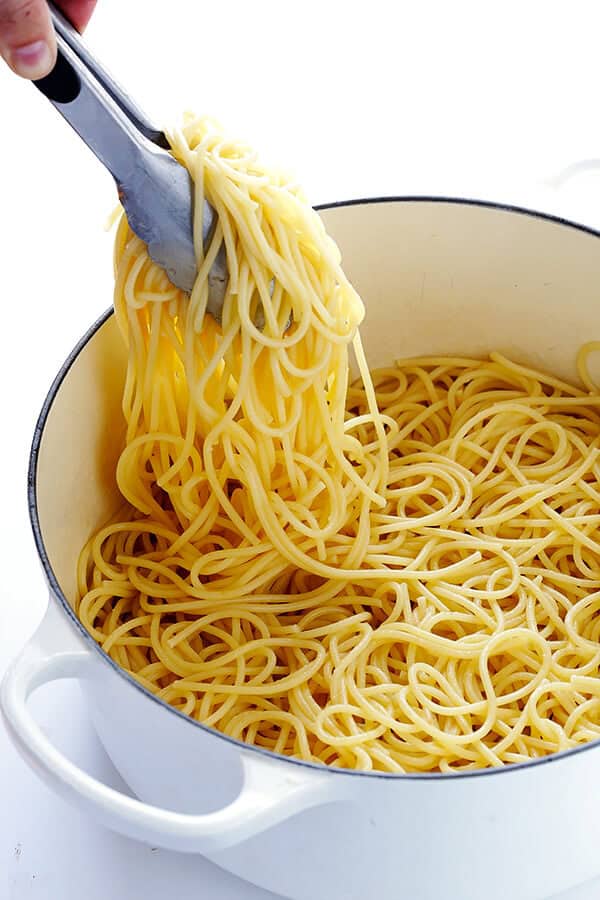
Hey guys! Thought I’d take the day off from sharing a recipe to instead share a Very Important Tip for all of you pasta lovers out there. This topic happens to be a little culinary soap box of mine, and one that I realize we’ve never directly discussed here on the blog.
I’m talking about how to properly salt your pasta water!
For years, I’ve heard people make comments about how pasta dishes they order in Italian restaurants (or even in Italy!) always seems to be so much more flavorful than the stuff they make at home. And my first question to them is always — “Do you generously salt your pasta water?!” More often than not, turns out that they don’t. They either skip the step entirely. Or if they do add salt, it’s usually only a small pinch or two, because they’re not sure how much to add, and they worry about over-salting the pasta or ingesting all of that sodium.
Here’s the deal:
You’ve gotta salt your pasta water, and you’ve gotta salt it generously.
Those precious moments while the pasta is boiling in the water are really the only time during the cooking process that you have the chance to season the actual pasta itself. (No one wants chunky salt on their pasta after it has been cooked!) And in order for it to be seasoned well, you need to make sure that your pasta water has a high enough salt ratio to actually make a difference with the relatively small volume of pasta that’s being cooked in it. Don’t worry, the pasta only technically soaks up a tiny fraction of a teaspoon per serving. But having properly salted pasta water will make a big difference with the flavor.
So how much salt should you use? When do you add it in? How much water should you use? How much pasta?
Here are my recommendations…
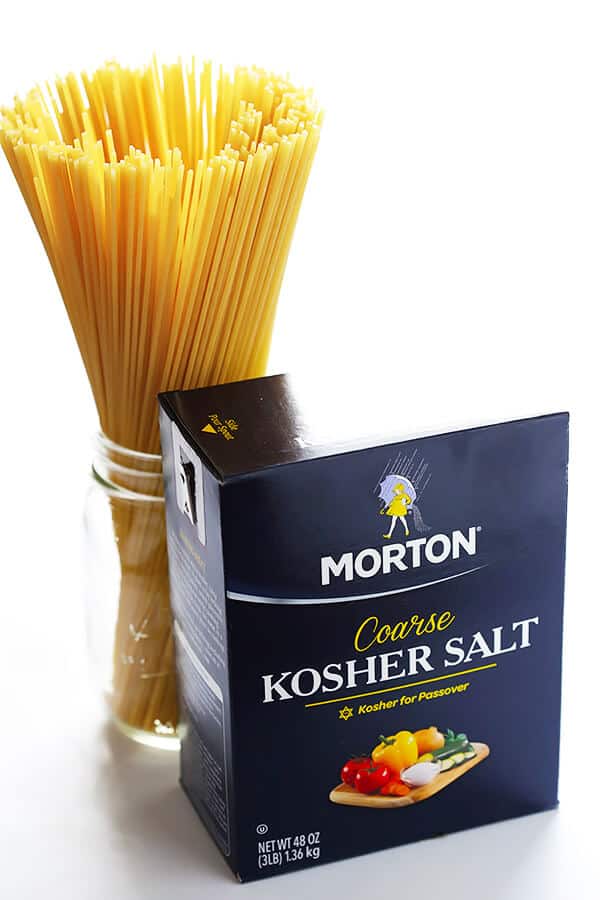
Well first, I should probably make the disclaimer that everyone will probably have a different opinion on this. And I highly recommend doing your own experimenting to find your perfect ratio. But to provide a starting point, I’ll share with you the basic formula that I’ve always used. It’s easy to remember — 1:1:4.
1 pound of pasta : 1 tablespoon salt : 4 quarts (16 cups) water
To break that down…
1 pound of pasta: Any shape of uncooked, dry pasta will work here. It can be traditional semolina pasta, whole wheat pasta, gluten-free pasta, you name it. 1 pound.
1 tablespoon salt: Actually, this one can very slightly depending on your type of salt. If you’re using table salt or sea salt, I recommend 1 tablespoon. But if you’re using Kosher salt (which I prefer), I recommend 1 “heaping” tablespoon (about 1.5 tablespoons). Or, if you happen to like really salty pasta like me, experiment with adding another half to full tablespoon and see what tastes good.
4 quarts (16 cups) water: This is how much water you need to fill approximately half of a traditional large stock pot, and how much water I recommend using to cook 1 pound of pasta. You can arguably use more or less, but this is my norm.
To cook the pasta, bring the water to a rolling bowl. Stir in the salt. Then cook the pasta al dente according to the package directions, then drain and serve.
So if you’re new to salting your pasta water, I highly recommend giving it a try!
Happy pasta making!

How To Properly Salt Your Pasta Water
- Prep Time: 5 minutes
- Cook Time: 10 minutes
- Total Time: 15 minutes
- Yield: 4 servings 1x
Description
Learn how to properly salt your pasta water with this 1:1:4 formula. It will definitely kick the flavor of your pasta up a delicious notch!
Ingredients
- 4 quarts (16 cups) water
- 1 tablespoon regular table salt (or 1.5 tablespoons Kosher salt)
- 1 pound (uncooked) dry pasta
Instructions
- In a large stockpot, bring the water to a rolling boil over medium-high heat. Stir in the salt.
- Add the pasta and cook it according to the package directions, stirring occasionally and reducing the heat a bit if it starts to boil over, until the pasta is al dente.
- Drain off the excess water.
- Serve immediately, using your favorite pasta recipe.
Notes
*If you like a saltier pasta, feel free to up the salt quantity by 1/2 tablespoon per batch until you find the amount that tastes good to you.


Thanks. I’ve been trying to get my wife to salt pasta and rice water for the last 40 years or so, always falls on deaf ears, or “if you don’t like it, don’t eat it”
Ah well, I guess that’s why my pasta always tastes better.
Add the salt after the water is boiling or at least very hot to avoid pitting of stainless steel. I just read that so I thought I would share but I always had added it in the beginning so I wouldn’t forget. My wife and I will ALWAYS ask the one who put the pot on if they added salt. It’s a habit and almost a joke by now.
Amen to the salt! Another tip i learned is to add some olive oil to the water. It kepps the pasta from sticking together. AND FINALLY, please do not rinse the cooked pasta in cold or hot water. I was horrified to see someone do this. Bland and Blah pasta again.
I love pasta and making it for others as well.
Wow, thank you very much, Ali, for sharing this guideline. This is very useful for me. Happy pasta making from now on.
LOVE this post!! Under seasoning pasta water, or any food for that matter is one of my culinary pet peeves!! So glad you’ve taken the time to write a post about it. Proper seasoning can make or break a meal!
Thank you, Kimberly — we’re glad you enjoyed it! :)
Thanks.. salt is an important factor in paste.. thanks for the tips..
this is a very useful advice for a mom who never salt the pasta water while cooking for kids like me xD seems like the pasta will be more tasty with it.
thanks for sharing, Hayley.
You’re welcome, but this is actually Ali’s blog, not mine (I just work with her). :)
Helpful!
WHY so much water
Because the pasta expands and you need to make sure you have enough room for this to happen.
I always salt my water at the beginning – it helps it come to a boil faster – but do you think it’s still seasoning the pasta the same way? I’ve never had any complaints, but have never consider adding it later.
Hey Rachel! This is what we found, via Smithsonian Magazine: “There is an old wives tale that says salt will also make the pasta water boil faster. This is not completely the case. Adding salt to water elevates the boiling point and to increase the boiling point of 1 quart of water by 1 degree Fahrenheit you would need 3 tablespoons of salt. And, that is way too much salt for anyone’s taste buds.” We honestly think you’re fine either way, especially if that’s how you’ve been doing it and it’s been working for you! :)
I can tell you for sure that if you don’t salt your water, your pasta will taste like plain wet cardboard.